






DIGITAL PRODUCT
Pânico de Estado
Political satire game in a 2D open world · two fictional Brazils
DEMOLIVE
CONTEXT
Political humor in games usually stops at a quiz or a one-screen minigame. Few use what a playable world allows: places to walk through, people with routines and choices that leave a mark.
WHAT WAS DONE
A browser game set in two fictional universes: in Lula's Brazil and in Flávio's Brazil the apocalyptic rumors come true, and the player, an ordinary citizen, completes six missions in each city, with choices that change the world and a closing ceremony. The ending ties both routes together: a survival-kit salesman profits from fear in both universes.
2 FICTIONAL BRAZILS · 12 MISSIONS
SOLUTIONS
Living city
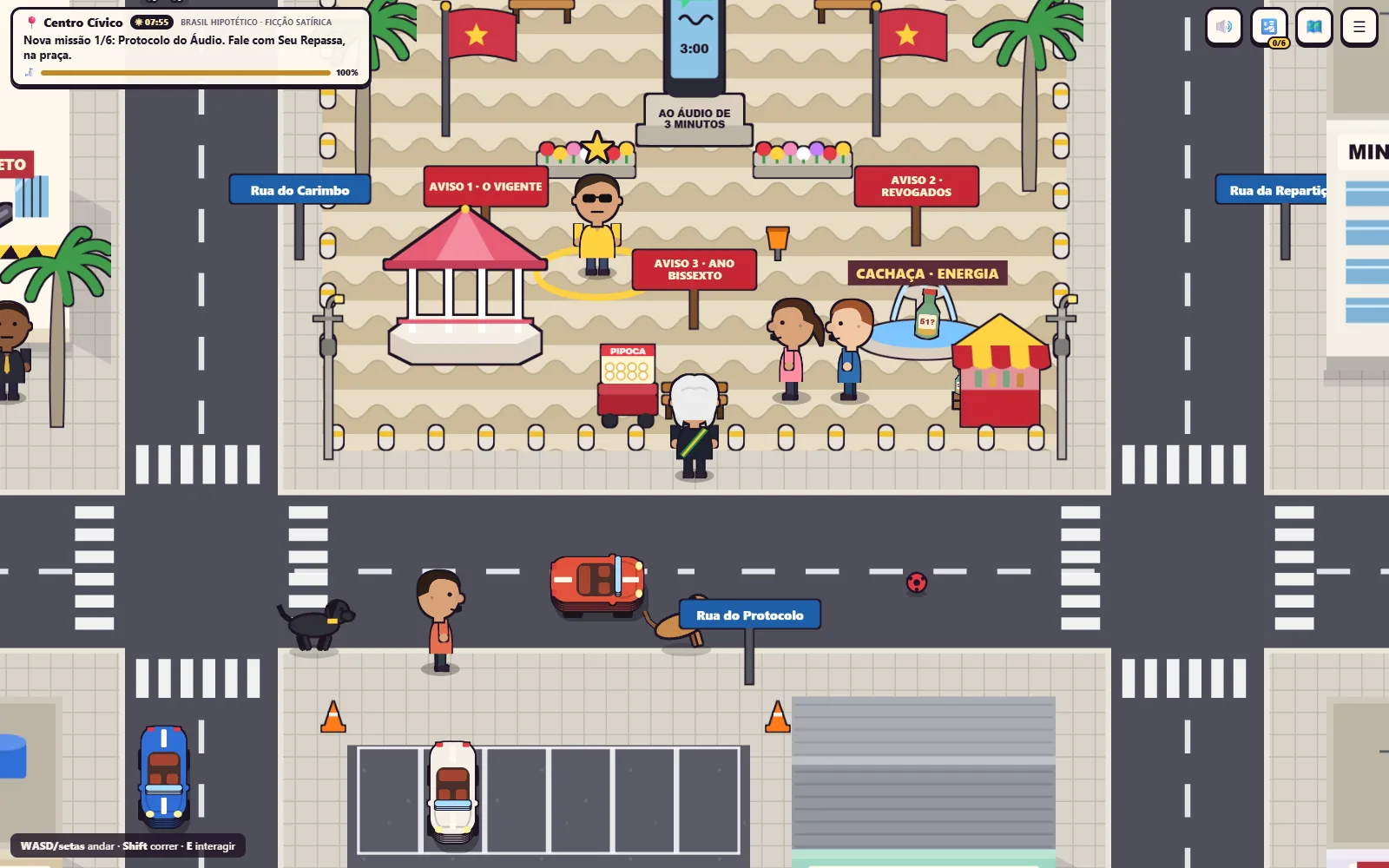
Residents with schedules, traffic taking turns at intersections and a clock where a day lasts 10 minutes.
Missions as data
A pure engine that takes events and returns effects; the scene only shows the consequences.
Choices that leave a mark
Obey, sabotage or reinterpret: every solution changes the world, goes into the save and returns in the closing ceremony.
Declared caricature
Satirical-fiction notice on the select screen and in the game panel, with lines invented for the work.
TECHNICAL DETAIL
01Lula's city is 4800 × 3600 px, with six districts and 46 buildings you can enter. Its 40 residents follow a real routine: they sleep at home…
Lula's city is 4800 × 3600 px, with six districts and 46 buildings you can enter. Its 40 residents follow a real routine: they sleep at home, leave in the morning, walk the sidewalks and crosswalks to their workplace, lunch at an establishment and head back, on a clock where a day lasts 10 real minutes. Up to 36 cars roam the streets and pick an exit at every intersection, one at a time. Flávio's Brazil is a separate city, with its own map and its own six missions.
02Missions are data (campanha.ts) and the engine is a pure function: it takes events (talked to, used, entered a place), applies effects and r…
Missions are data (campanha.ts) and the engine is a pure function: it takes events (talked to, used, entered a place), applies effects and returns outputs, while the scene only emits events and shows the consequences. That lets every solution (obey, sabotage or reinterpret the order) change something visible in the world, get recorded in the save and show up in the closing ceremony. There are no coins, XP or punishment: getting it wrong doesn't penalize the player.
03Buildings, street objects and furniture are SVG drawn in code, and a culler keeps only what is near the camera visible, so a city this size …
Buildings, street objects and furniture are SVG drawn in code, and a culler keeps only what is near the camera visible, so a city this size runs in the browser. The satire has a rule: the character select and the game panel carry a fixed notice that it is fiction ("Hypothetical Brazil · satirical fiction") and that nothing there depicts real facts.
SCREENS
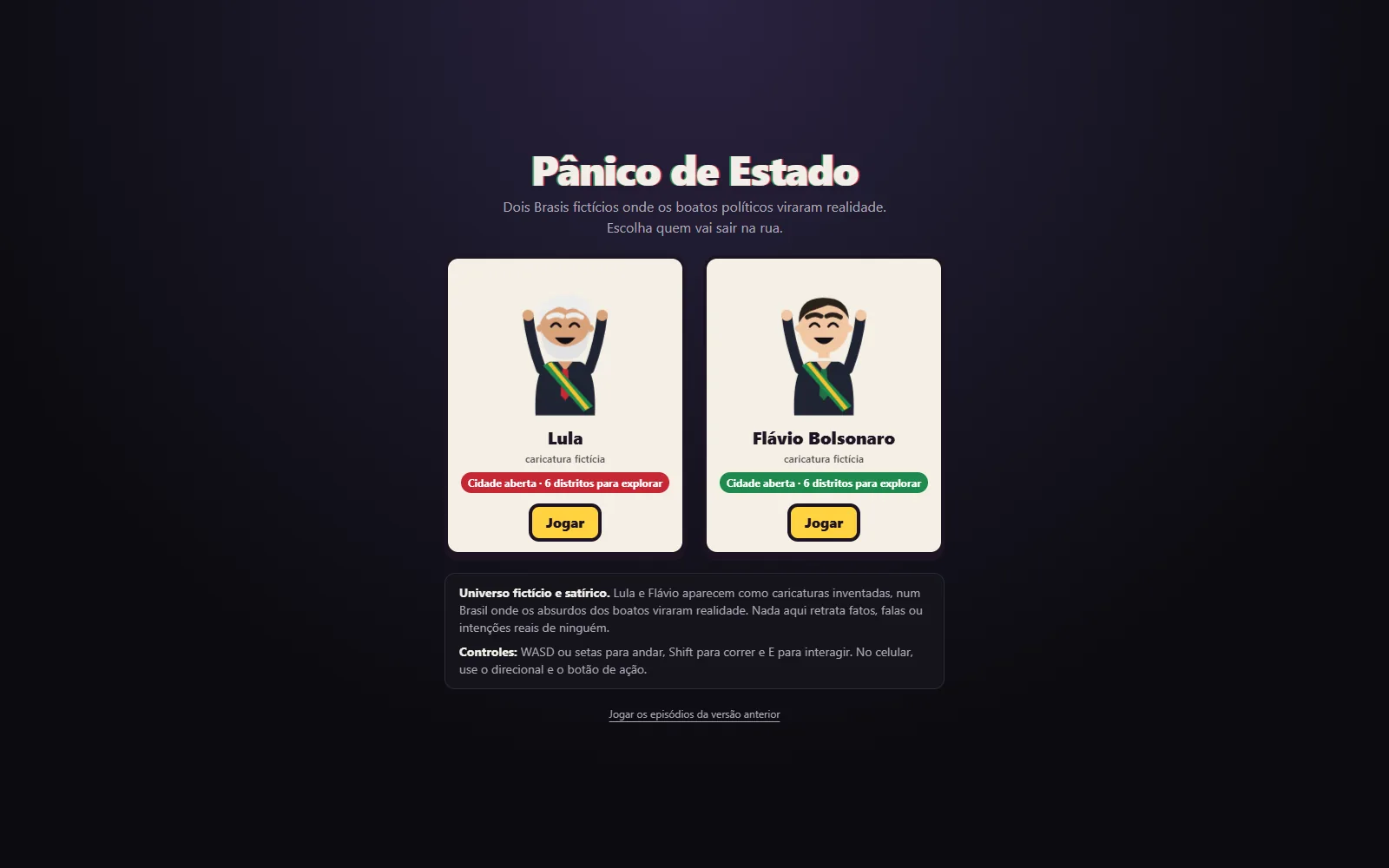
01 Character select: Lula or Flávio Bolsonaro as fictional caricatures, with the satire notice
RESULT
A browser game set in two fictional universes: in Lula's Brazil and in Flávio's Brazil the apocalyptic rumors come true, and the player, an ordinary citizen, completes six missions in each city, with choices that change the world and a closing ceremony. The ending ties both routes together: a survival-kit salesman profits from fear in both universes.
Satire: Lula and Flávio Bolsonaro appear as explicitly fictional caricatures, with lines invented for the work. Nothing there portrays anyone's real facts, statements or intentions.